Competitor Analysis: Multi-Agent Research
Send a product URL or a short description from Telegram, WhatsApp, Slack or a Google Doc. Nine AI research agents investigate the market, and a sourced competitor analysis plus a designed visual report arrive by email.
Status: built in n8n, not yet run on live data. Self-initiated portfolio project; no client data. We will add sample outputs once it has been run and checked.
The problem
Competitor research for a small team usually means a few tabs, a chatbot summary without sources, and a doc that goes stale. Pricing, positioning, ICP and objections are rarely compared side by side.
How it works, in plain words
You a person on your team AI an AI step Auto runs by itself
- You
Send a link
A product URL or short description, from Slack, Telegram, WhatsApp or a Google Doc.
- AI
It studies the product
Reads the page and searches the web to understand what you sell.
- AI
It finds the competitors
Small, mid-size and large players, each with sources.
- AI
Six researchers work at once
Features, positioning, buyers, pricing, objections and videos.
- Auto
A report lands in your inbox
A visual report plus the raw research, every claim with its source.
Your part: check pricing and claims before acting on them. The agents cite sources and mark unknowns as “not public”, but AI research can still be wrong.
- A few tabs and a chatbot summary with no sources
- Pricing and positioning never compared side by side
- Notes that go stale
- Nine agents research in parallel, six at the same time
- Every claim has a source; unknowns are marked, not guessed
- Report and raw research arrive by email
See the real build (n8n)
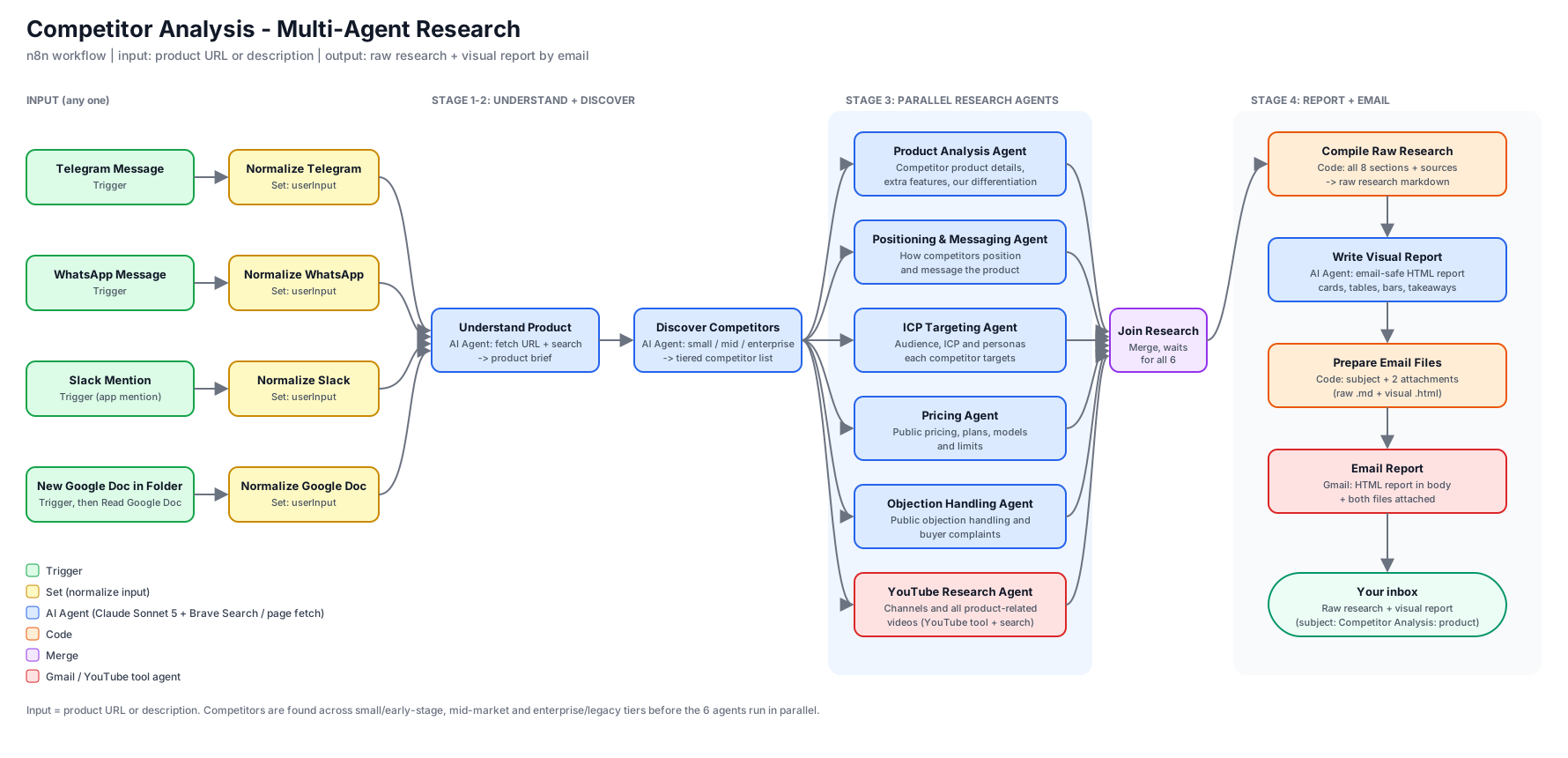
- Input from anywhere: Telegram, WhatsApp, a Slack mention, or a new Google Doc in a folder. All are normalised into one input.
- Understand the product: an agent reads the page and searches the web to write a product brief.
- Discover competitors across three tiers: small/early, mid-market, enterprise/legacy, with sources.
- Six agents research in parallel: product and features, positioning and messaging, ICP and personas, public pricing, objection handling and buyer complaints, YouTube videos.
- Compile and design: all research is merged with sources, then an agent writes an email-safe visual report.
What you get
- An email with the visual report: executive summary, tiered competitor cards, feature and positioning tables, persona cards, pricing comparison, objection playbook, video list, recommended actions and sources
raw-research.md: every section in full, with sourcesvisual-report.html: the same report as a standalone file
How it's built
| Part | Detail |
|---|---|
| Platform | n8n, 47 nodes |
| AI | 9 agents, each with its own Claude model node |
| Tools | Web search, page fetch, YouTube search |
| Inputs | Telegram, WhatsApp, Slack, Google Docs |
| Delivery | Gmail with HTML body and two attachments |
Reliability
- Agents must cite sources and mark unknowns; pricing shows "not public" rather than a guess
- Research waits for all six agents before compiling, so no section is silently missing
- Public information only; objection handling uses public reviews
Limits and next steps
- Several minutes and meaningful AI usage per run
- AI research can still be wrong: verify pricing and claims before acting
- Planned: chat acknowledgement, per-agent retries, saving to Drive/Notion, scheduled re-runs to track changes
Want this for your market?
Start with a founding GTM report, or have this workflow set up for your team.