The GTM Strategy Report: research first, then strategy
We don't start with an ICP, a marketing plan or ads. We study the market, what customers actually say, and the competition, then test whether the opportunity is worth it. Only then does it become a practical go-to-market plan.
The approach
Research the market → validate the problem → pick the right customers → define the offer → position it → choose channels → execute → measure → iterate.
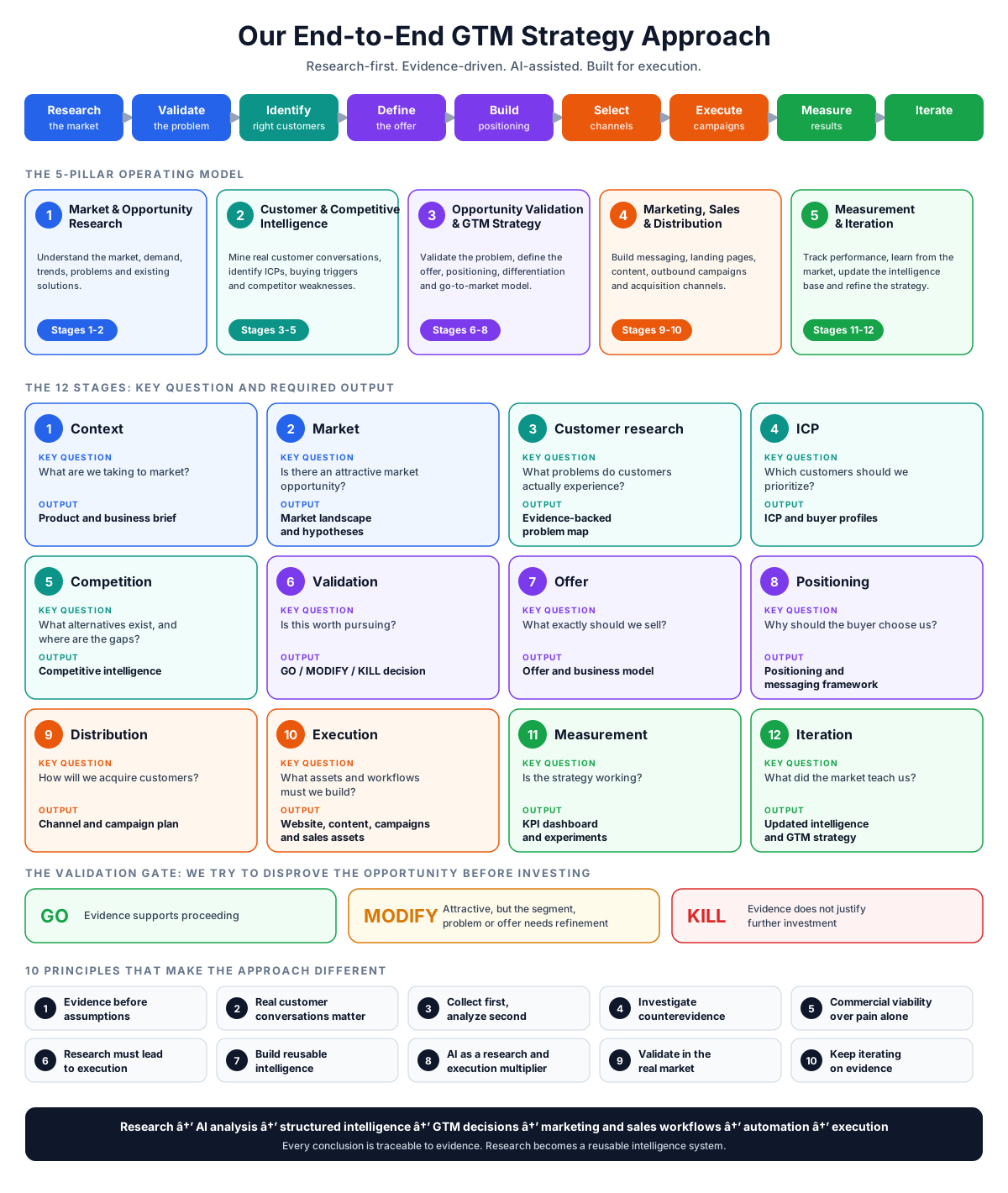
| Pillar | What it does |
|---|---|
| Market & opportunity research | Market, demand, trends, problems and existing solutions |
| Customer & competitive intelligence | Real customer conversations, ICPs, buying triggers, competitor gaps |
| Validation & GTM strategy | Validate the problem; define the offer, positioning and model |
| Marketing, sales & distribution | Messaging, pages, content, outbound and channels |
| Measurement & iteration | Track, learn, update the research and refine |
12 stages, each with one question
| Stage | Key question | Output |
|---|---|---|
| 1 Context | What are we taking to market? | Product and business brief |
| 2 Market | Is there an attractive opportunity? | Market landscape and hypotheses |
| 3 Customer research | What problems do customers actually have? | Evidence-backed problem map |
| 4 ICP | Which customers come first? | ICP and buyer profiles |
| 5 Competition | What alternatives exist, and where are the gaps? | Competitive intelligence |
| 6 Validation | Is this worth pursuing? | GO / MODIFY / KILL |
| 7 Offer | What exactly should we sell? | Offer and business model |
| 8 Positioning | Why should the buyer choose us? | Positioning and messaging |
| 9 Distribution | How will we reach buyers? | Channel and campaign plan |
| 10 Execution | What must we build? | Pages, content, campaigns, sales assets |
| 11 Measurement | Is it working? | KPI dashboard and experiments |
| 12 Iteration | What did the market teach us? | Updated research and strategy |
The validation gate
We try to disprove the opportunity, not just collect evidence for it: is the problem frequent and costly, is there urgency, do buyers already spend on it, can we reach them, and is there willingness to pay? Then an explicit decision:
- GO: the evidence supports proceeding
- MODIFY: promising, but the segment, problem or offer needs refining
- KILL: the evidence doesn't justify more investment
What's in the report
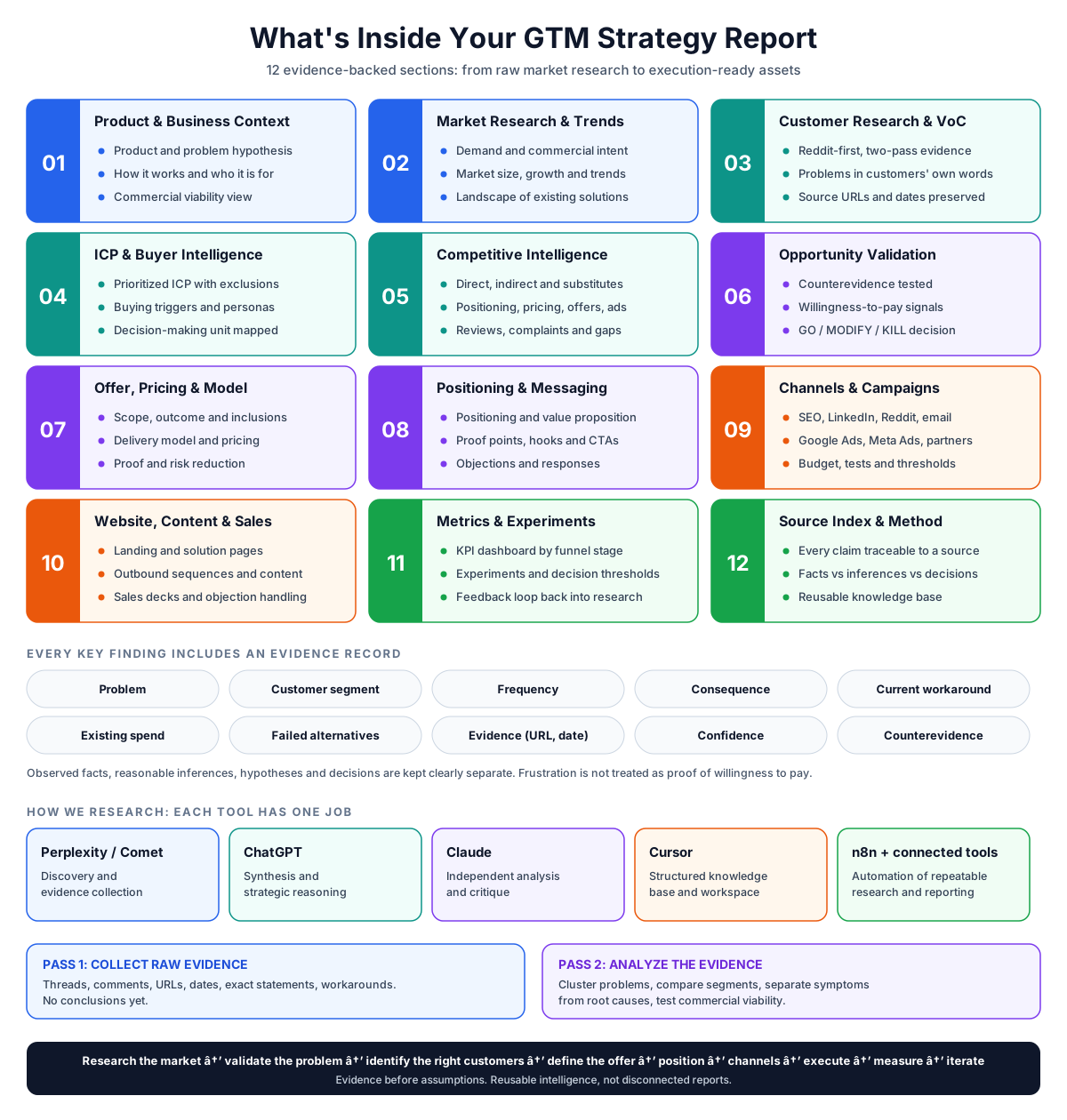
Every major conclusion traces back to its evidence. We keep observed facts, inferences, hypotheses and decisions separate, so the strategy can be revisited when the market changes.
Principles
- Evidence before assumptions
- Customer conversations and original sources
- Collect first, analyse second
- Look for counterevidence
- Commercial viability, not just pain
- Every phase feeds the next
- Build reusable intelligence
- AI as a multiplier, with distinct roles and verified outputs
- Validate in the real market
- Keep iterating
Start with a founding GTM report
$399 for the first 10 clients: a call and a full sourced report within a week.